
📞 Tel:+86-750-3857665
Email:sales@enpowertec.com
Email:sales@enpowertec.com
Two-way radios are widely used in security, construction, hospitality, transportation, emergency response, industrial operations, and other professional environments. For these applications, a reliable battery is essential for maintaining stable communication throughout the working day.
Choosing the right two-way radio battery involves more than simply matching the battery size. Battery chemistry, voltage, capacity, connector design, protection functions, and radio compatibility all need to be considered.
In this guide, Enpower explains the key factors to consider when selecting or sourcing replacement and custom two-way radio batteries.
A two-way radio battery is a rechargeable battery pack specifically designed to provide portable power for professional handheld radios and communication equipment.
Depending on the radio model and application, batteries may use different cell chemistries, voltage levels, capacities, housing designs, and electrical protection systems.
For professional users and B2B buyers, the battery should provide:
Stable voltage output
Sufficient operating capacity
Reliable charging performance
Protection against over-charge and over-discharge
Short-circuit and over-current protection
Suitable mechanical dimensions
Reliable electrical contacts
Compatibility with the target radio
A correctly matched battery helps reduce unexpected power interruptions and improves the reliability of communication equipment.
Two-way radio batteries are commonly manufactured using several different battery chemistries.
Nickel-cadmium batteries have been widely used in older professional radio systems.
Typical characteristics include:
Durable construction
Good performance in demanding environments
Relatively stable discharge characteristics
Suitable for some legacy radio models
However, Ni-Cd batteries have lower energy density than many modern lithium-based batteries, so they are gradually being replaced in many applications.
Nickel-metal hydride batteries are another common solution for professional communication equipment.
Advantages include:
Higher capacity than many traditional Ni-Cd packs
No cadmium content
Suitable for replacement battery applications
Available in various custom pack configurations
Enpower supplies Ni-MH replacement battery packs for a range of professional two-way radios.
Lithium-ion batteries are widely used in modern professional communication equipment because of their high energy density and compact design.
Typical advantages include:
High energy density
Lightweight construction
High capacity
Compact battery design
Suitable for long operating periods
Li-ion battery packs can also be designed with protection circuits for over-charge, over-discharge, over-current, short circuit, and temperature monitoring.
Battery voltage is one of the most important specifications when selecting a replacement battery.
Common professional radio battery voltages include:
3.6V / 3.7V
7.2V / 7.4V
10.8V / 11.1V
Other customized voltage configurations
The correct voltage depends on the original battery design and the radio's electrical requirements.
For example, Enpower manufactures different battery configurations for professional handheld radios, including:
Suitable for certain compact radio and data collection applications.
Commonly used for professional handheld two-way radios and other portable communication equipment.
Used for selected tactical and professional communication systems requiring higher voltage and capacity.
Using an incorrect battery voltage may result in:
Radio malfunction
Insufficient operating power
Charging problems
Reduced battery performance
Potential damage to the equipment
Therefore, buyers should always confirm the original battery voltage or equipment requirements before ordering a replacement battery.
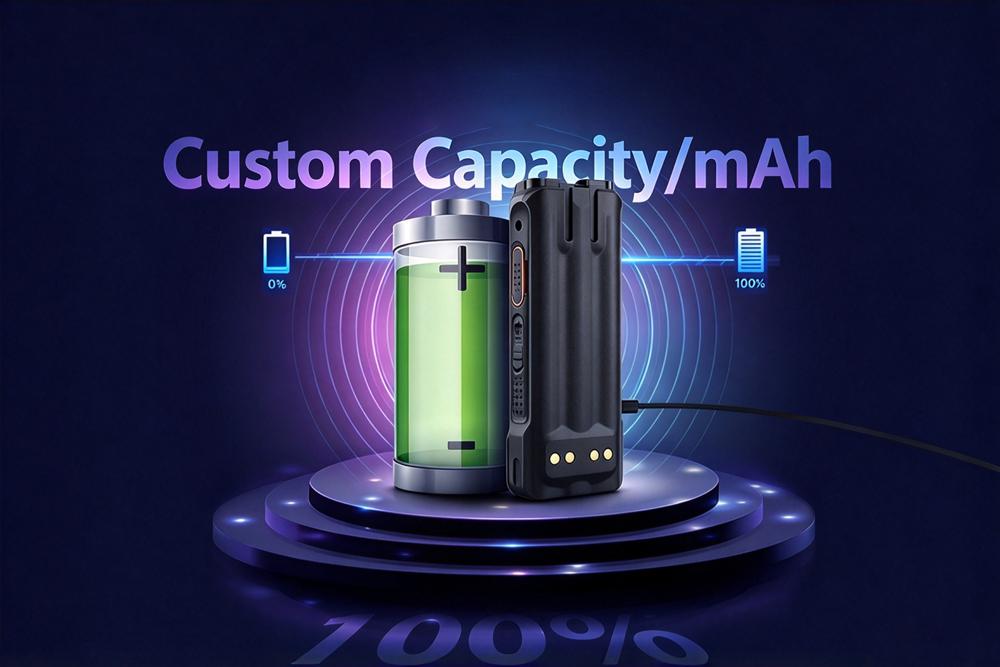
Battery capacity is usually expressed in mAh (milliamp-hours).
In simple terms, a higher mAh rating generally means that the battery can store more electrical energy, although actual operating time also depends on the radio's power consumption, transmission frequency, operating conditions, and battery age.
For example:
1100mAh - suitable for some compact or legacy radio applications
1800mAh-2200mAh - common capacity range for professional handheld radios
5000mAh and above - suitable for certain higher-capacity or tactical communication systems
When selecting a replacement battery, higher capacity is not automatically better.
The battery must also fit the radio's:
Physical dimensions
Electrical specifications
Charging system
Protection circuit
Connector/contact structure
A properly engineered battery pack balances capacity, size, weight, current output, and compatibility.
Compatibility is one of the most important factors for two-way radio battery buyers.
A compatible battery should match the original equipment in several areas.
Always verify the exact radio model number.
Different radio models may use batteries with similar appearances but different electrical or mechanical specifications.
The original battery part number is often one of the most useful references when sourcing a replacement battery.
For example, buyers can provide:
This information allows a battery manufacturer to evaluate the required replacement solution.
The replacement battery needs to fit correctly into the radio battery compartment.
Important dimensions may include:
Length
Width
Height
Contact position
Housing structure
Contact design is also critical.
Different radio batteries may use different:
Contact positions
Contact materials
Contact quantities
Connector structures
Reliable electrical contacts help ensure stable power transmission between the battery and radio.
Enpower develops replacement and custom battery packs for various professional communication applications.
Typical products include:
Designed for professional handheld radios used in:
Security
Hotels
Construction
Warehouses
Transportation
Event management
Industrial operations
Higher-capacity battery solutions can be developed for selected tactical and professional communication equipment.
These battery packs may require specific dimensions, high-capacity cells, protection circuits, and customized electrical interfaces.
Battery packs are also used in handheld barcode scanners and mobile data collection equipment.
These applications often require precise mechanical dimensions and reliable long-duration operation.
Modern rechargeable battery packs can incorporate protection functions to improve operational safety and reliability.
Depending on the battery chemistry and application, protection features may include:
Helps prevent the battery from being charged beyond the designed voltage range.
Helps prevent excessive discharge that could negatively affect battery performance and service life.
Helps protect the battery pack when current exceeds the designed operating range.
Helps reduce the risk caused by accidental short circuits.
An NTC temperature sensor can be integrated into selected battery packs to monitor battery temperature during charging or operation.
For customized battery projects, the protection strategy should be designed according to the battery chemistry, operating conditions, charger, and equipment requirements.
Before purchasing a replacement or custom battery, we recommend confirming the following information:
| Specification | Information to Confirm |
|---|---|
| Radio Model | Exact equipment model |
| Original Battery P/N | OEM or existing battery part number |
| Battery Chemistry | Ni-Cd, Ni-MH, Li-ion, etc. |
| Voltage | V |
| Capacity | mAh / Ah |
| Dimensions | Length x Width x Height |
| Contacts | Position and structure |
| Charger | Original or customized charger |
| Operating Environment | Temperature, vibration, outdoor/industrial use |
| Required Quantity | Sample, small batch or mass production |
Providing these details can significantly improve the accuracy of battery selection and customization.
Different communication equipment may require different battery specifications. For OEM replacement projects, equipment upgrades, or new product development, a standard battery may not always meet the application requirements.
Enpower provides custom battery pack design and manufacturing for professional communication equipment.
Our customization process can include:
Customized parameters may include:
Battery chemistry
Rated voltage
Nominal capacity
Continuous discharge current
Peak pulse current
Charging parameters
Battery dimensions
Connector/contact design
Protection functions
Housing materials
Temperature monitoring
Depending on the project requirements, Enpower can develop solutions using Li-ion, LiFePO4, and Ni-MH battery technologies.
For distributors, equipment repair companies, system integrators, rental companies, and industrial equipment manufacturers, working directly with a battery manufacturer can provide more flexibility than purchasing a standard off-the-shelf battery.
A battery manufacturer can support:
OEM replacement battery development
Custom battery pack design
Small-batch sampling
Mass production
Customized capacity
Customized voltage
Housing and connector customization
Protection circuit development
Battery testing
Private-label and OEM projects
This is particularly useful when the original battery is discontinued, difficult to source, or no longer meets the requirements of a new equipment design.
Choosing the right two-way radio battery requires careful consideration of battery chemistry, voltage, capacity, dimensions, contacts, charging requirements, protection functions, and equipment compatibility.
For a simple replacement project, the original battery model and part number can provide a useful starting point. For OEM, industrial, or large-volume applications, a customized battery solution may provide greater flexibility.
Enpower specializes in custom battery pack design and manufacturing for professional communication equipment and industrial applications.
If you are looking for a replacement two-way radio battery or need a customized battery pack for a new communication device, provide us with your equipment model, original battery part number, voltage, capacity, dimensions, and required quantity. Our engineering team can evaluate the specifications and develop a suitable battery solution for your application.

Enpower integrates R&D, production and quality testing in-house, supporting custom battery solutions for worldwide buyers.