
📞 Tel:+86-750-3857665
Email:sales@enpowertec.com
Email:sales@enpowertec.com
Crane remote control batteries play an essential role in the safe and reliable operation of industrial wireless control systems. Whether used in overhead cranes, tower cranes, mobile hydraulic equipment, or concrete pump trucks, the right battery helps operators maintain stable communication with their equipment and minimize unexpected downtime.
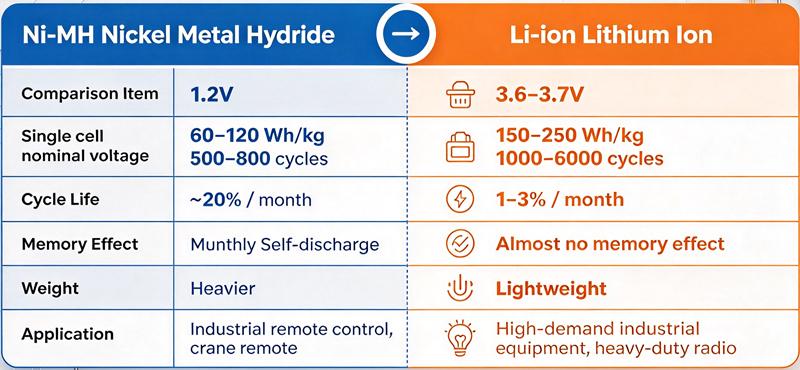
Two common battery technologies used in industrial remote controls are Nickel-Metal Hydride (Ni-MH) and Lithium-ion (Li-ion). Although both can provide reliable power, they differ in energy density, weight, charging characteristics, maintenance requirements, and application suitability.
In this guide, Enpower explains the key differences between Ni-MH and Li-ion crane remote control batteries to help equipment manufacturers, distributors, maintenance companies, and industrial battery buyers choose the right solution.
A Nickel-Metal Hydride (Ni-MH) battery is a rechargeable battery widely used in industrial wireless remote controls. Many established crane control systems use Ni-MH battery packs because of their proven performance and compatibility with existing equipment.
Ni-MH batteries are available in various voltage and capacity configurations to meet the power requirements of different industrial remote control systems.
Key advantages of Ni-MH crane remote control batteries:
Established technology: Widely used in many industrial remote control applications.
Reliable operation: Suitable for routine industrial use when properly selected and maintained.
Compatibility with existing equipment: A practical replacement option for systems originally designed for Ni-MH battery packs.
Rechargeable design: Supports repeated charging and discharging during normal operation.
Potential limitations:
Lower energy density than many Li-ion batteries, which can result in a heavier battery pack for the same amount of stored energy.
Higher self-discharge than many modern Li-ion battery systems, depending on cell design and storage conditions.
Charging requirements and charging times vary according to battery capacity, charger design, and operating conditions.
Ni-MH batteries are often a suitable choice when maintaining compatibility with established crane remote control systems is the primary concern.
Lithium-ion (Li-ion) batteries are increasingly used in portable industrial equipment because of their high energy density and flexible battery pack design. Depending on the original equipment specifications, a Li-ion battery can provide a lighter and more compact power solution for industrial wireless remote controls.
A Li-ion battery pack typically incorporates a battery management or protection system designed to help manage charging, discharging, current, and temperature conditions.
Key advantages of Li-ion crane remote control batteries:
High energy density: Can provide more energy in a smaller and lighter package.
Low self-discharge: Generally retains its charge well during storage when compared with conventional Ni-MH batteries.
Flexible pack design: Offers options for customized dimensions, voltage, capacity, and protection features.
Efficient power delivery: Can support the electrical requirements of compatible industrial remote control systems.
Potential limitations:
Requires a compatible charger designed for the specific Li-ion battery chemistry and configuration.
Protection circuitry and charging controls must be properly designed.
Replacing a Ni-MH battery with a Li-ion battery is not always a direct swap. Voltage, connector configuration, charging method, dimensions, and communication requirements must be verified.
For equipment manufacturers and industrial users seeking a compact, lightweight power solution, Li-ion technology may be an attractive option when the remote control system supports it.
The following table summarizes the main differences between the two battery technologies.
| Comparison | Ni-MH Battery | Li-ion Battery |
|---|---|---|
| Energy density | Generally lower | Generally higher |
| Battery pack weight | Often heavier for equivalent energy | Often lighter for equivalent energy |
| Self-discharge | Generally higher | Generally lower |
| Charging requirements | Ni-MH-compatible charger | Chemistry- and configuration-compatible Li-ion charger |
| Protection requirements | Appropriate charging and safety controls | Typically requires dedicated protection circuitry |
| Replacement suitability | Ideal for compatible Ni-MH systems | Suitable for equipment designed for the specific Li-ion pack |
| Customization | Voltage, capacity, dimensions and connectors | Voltage, capacity, dimensions, connectors and protection features |
| Common consideration | Existing system compatibility | Weight, size, energy density and electronic compatibility |
The best battery depends on your equipment, operating environment, and replacement requirements.
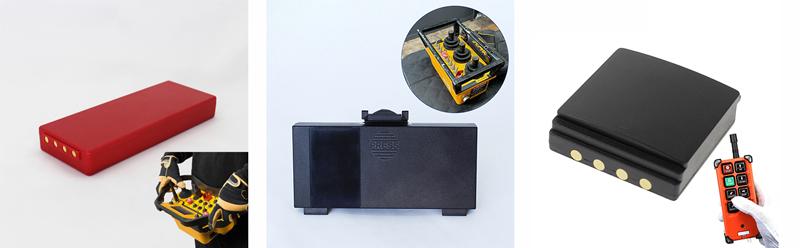
Your crane remote control was originally designed for a Ni-MH battery.
You need a replacement battery that maintains the original voltage and charging specifications.
Your equipment manufacturer specifies Ni-MH chemistry.
You want to maintain an established battery and charger configuration.
Your equipment is designed to support a Li-ion battery pack.
Lower battery weight and compact dimensions are important.
You need a customized battery pack with specific voltage and capacity requirements.
Your application benefits from lower self-discharge and a suitable integrated protection system.
Ni-MH is often a practical option for replacement batteries used in existing crane remote control systems.
Before selecting Li-ion, confirm that the remote control, charging system, and battery protection design are compatible with the proposed battery pack.
Choosing a replacement battery involves more than comparing Ni-MH and Li-ion technology. Several technical details must be checked before placing an order.
The nominal voltage must meet the equipment manufacturer's specifications. A battery with an incorrect voltage may cause operational problems or damage the equipment.
Capacity, measured in milliamp-hours (mAh) or amp-hours (Ah), affects how much energy a battery can store. A higher-capacity battery may offer longer operating time if its dimensions, discharge capability, and electrical characteristics are suitable.
The replacement pack must fit the battery compartment and match the required contacts or connector arrangement.
Ni-MH and Li-ion batteries use different charging methods. Always use a charger approved for the specific battery chemistry and pack configuration.
Depending on the design, battery packs may require overcharge, over-discharge, overcurrent, short-circuit, and temperature protection. The battery must also be suitable for the operating temperature range of the equipment.
Check the original battery part number, remote control model, voltage, and connector before selecting a replacement. Two batteries that look similar may not be electrically interchangeable.
At Enpower Technology, we manufacture battery packs for industrial applications, including crane remote controls, wireless industrial transmitters, and other specialized equipment.
We support customized battery solutions based on customer specifications and equipment requirements, helping B2B buyers source suitable replacement battery packs for their applications.
Our customization options may include:
Battery chemistry: Ni-MH and Li-ion solutions, subject to application requirements.
Voltage and capacity: Configurations tailored to the specified electrical requirements.
Dimensions and housing: Battery pack designs developed to meet available installation space.
Connectors and contacts: Configurations based on equipment interface requirements.
Protection features: Appropriate protection solutions according to the battery chemistry and application.
OEM and replacement projects: Support for distributors, equipment manufacturers, maintenance providers, and industrial battery suppliers.
Whether you need a replacement Ni-MH battery for an existing crane remote control or a customized Li-ion battery pack for compatible equipment, our team can help evaluate your requirements.
Not always. Even if the battery fits the same compartment, differences in voltage, charging methods, protection circuitry, and equipment compatibility may prevent a direct replacement. Confirm the specifications with the equipment manufacturer or a qualified battery supplier before making a change.
Li-ion batteries generally have lower self-discharge and higher energy density. However, actual service life depends on cell quality, battery pack design, operating conditions, charging practices, and usage patterns. Battery chemistry alone does not guarantee a longer service life.
Ni-MH may be the better option for equipment designed around Ni-MH technology. Li-ion may be preferable for compatible equipment that benefits from a lighter or more compact battery pack. The correct choice depends on the original equipment specifications and operating requirements.
Yes. Enpower supports customized industrial battery pack projects based on required voltage, capacity, dimensions, connectors, chemistry, and application-specific protection requirements. Providing the original battery label, part number, or equipment model helps our team evaluate the project.
Both Ni-MH and Li-ion crane remote control batteries offer practical advantages for industrial applications. Ni-MH remains a reliable choice for many established systems, while Li-ion provides opportunities for lighter and more compact battery pack designs where compatibility permits.
The most important factors are equipment compatibility, correct voltage, suitable capacity, charging requirements, and reliable protection design.
Website: https://www.enpowertec.com/

Enpower integrates R&D, production and quality testing in-house, supporting custom battery solutions for worldwide buyers.