
📞 Tel:+86-750-3857665
Email:sales@enpowertec.com
Email:sales@enpowertec.com
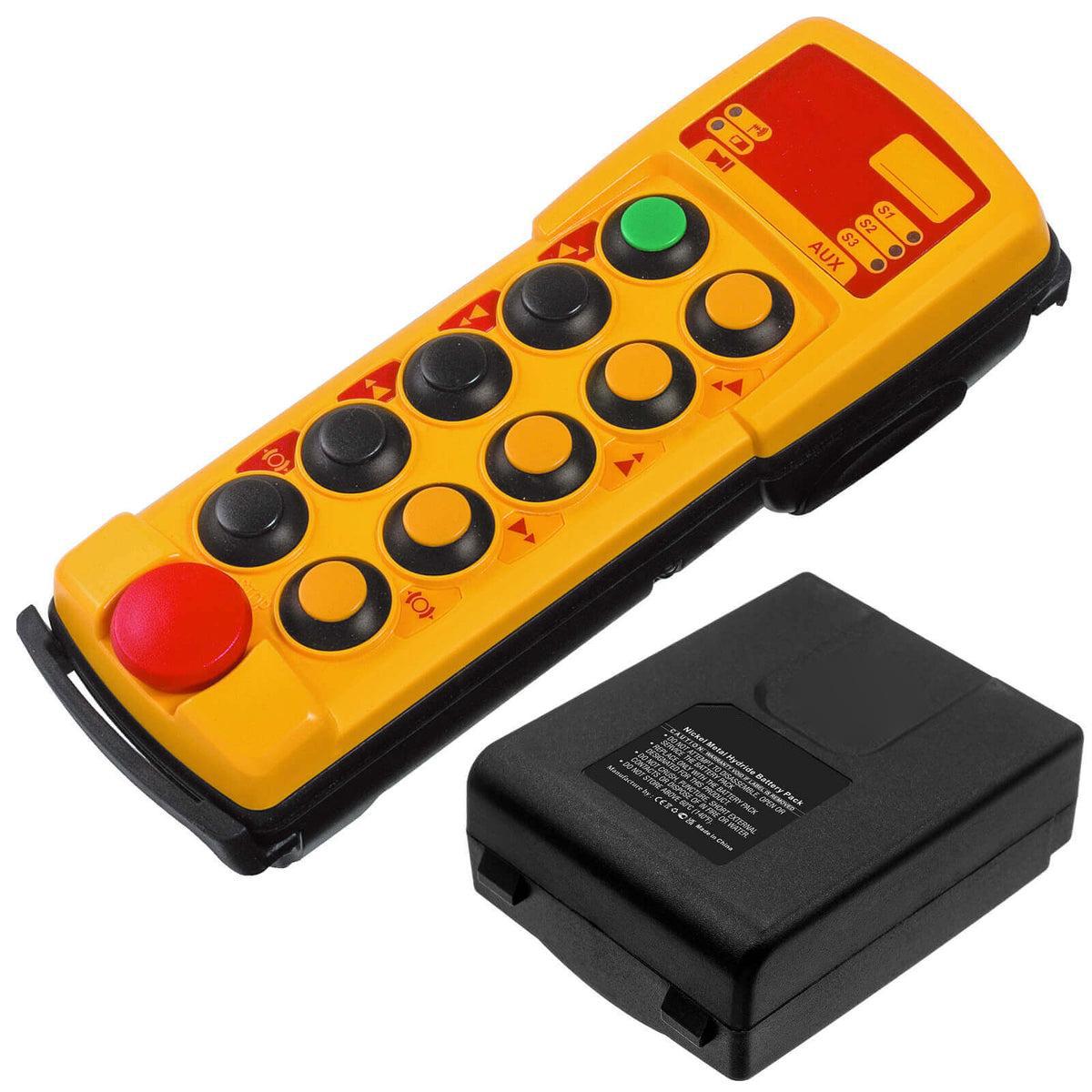
Replacing a crane remote control battery may seem like a simple maintenance task, but choosing the wrong replacement battery can lead to charging problems, reduced operating time, poor electrical connections, or unexpected equipment downtime.
Crane remote control batteries are widely used in overhead cranes, mobile cranes, concrete pumps, forestry machinery, material handling equipment, and other industrial applications. These devices often operate in demanding environments, making battery compatibility and reliability important considerations.
Whether you are an equipment operator, maintenance technician, industrial battery distributor, or purchasing manager, knowing what to check before ordering a replacement battery can help you avoid unnecessary costs and keep your equipment operating reliably.
In this guide, we explain the key factors to consider when selecting a replacement crane remote control battery.
The first step is to identify the model number of your existing crane remote control battery.
Many industrial remote control manufacturers offer multiple battery models with similar appearances but different electrical specifications or connector configurations. A battery that looks almost identical to the original may not be compatible with your equipment.
Before purchasing a replacement, check:
If the original model number is unavailable, provide clear photographs of the battery label, connector, dimensions, and remote control model to your battery supplier.
Voltage is one of the most important specifications when replacing a crane remote control battery.
Industrial remote controls use different voltage levels depending on their design and power requirements. A replacement battery must meet the voltage requirements specified by the equipment manufacturer.
For example, some industrial crane remote control battery models use 3.6V, 6V, or 7.2V battery configurations. These are illustrative examples, not universal standards for every remote control.
When checking voltage, pay attention to:
If you are uncertain about the correct voltage, consult the original equipment documentation or a qualified battery manufacturer before ordering.
Crane remote control batteries may use different rechargeable battery chemistries, including Ni-MH, Ni-Cd in some older equipment, and Li-ion.
Each chemistry has different charging requirements, performance characteristics, and maintenance considerations.
| Battery type | Main characteristics | What to check before replacement |
|---|---|---|
| Ni-MH | Rechargeable and commonly used in industrial battery packs | Confirm voltage, capacity, connector, and compatible charging method. |
| Ni-Cd | Found in some legacy industrial equipment | Verify the original specification and check applicable environmental and disposal requirements. |
| Li-ion | High energy density and generally low self-discharge | Confirm the exact battery configuration, compatible charger, and required protection features. |
When replacing a battery, do not switch to a different chemistry solely because the new battery has the same voltage.
Battery capacity affects how long a crane remote control can operate between charges.
Capacity is usually expressed in milliamp-hours (mAh) or amp-hours (Ah). A higher-capacity battery may provide longer operating time, but only if it is compatible with the remote control and its charging system.
Before choosing a replacement crane remote control battery, consider:
For equipment used in long shifts, a suitable higher-capacity replacement may help reduce charging frequency. However, a larger capacity does not automatically guarantee better performance or longer service life.
The battery must still fit correctly, meet the required electrical specifications, and work with the approved charger.
Physical compatibility is just as important as electrical compatibility.
Even if two crane remote control batteries have the same voltage and capacity, differences in dimensions, terminal positions, or connector design may prevent proper installation.
Check the following details:
Measure the length, width, and height of the original battery. Make sure the replacement fits inside the battery compartment without forcing the housing closed.
Compare the connector shape, pin arrangement, terminal spacing, and contact orientation.
Inspect the original contacts for corrosion, wear, looseness, or damage.
Confirm that the replacement housing fits securely and does not interfere with the battery cover or locking mechanism.
Verify the correct orientation and polarity according to the manufacturer's instructions.
A replacement battery must be compatible with the charging system used by your crane remote control.
This is especially important when replacing an older battery with a different model or considering a change in battery chemistry.
Before ordering, check:
For example, a charger designed for a Ni-MH battery pack should not automatically be used with a Li-ion replacement. The charging methods and safety requirements can differ significantly.
If the original charger is no longer available, consult the battery or remote control manufacturer for a compatible replacement charging solution.
Crane remote controls are frequently used in factories, warehouses, construction sites, forestry operations, and outdoor material handling environments.
These working conditions can affect battery performance and service life.
Before selecting a replacement battery, consider:
Check the manufacturer's operating and charging temperature limits.
Determine whether the battery and remote control require protection from rain, humidity, or splashes.
Consider the working environment and the condition of the battery compartment.
Check that the battery housing and connections are suitable for the equipment's operating conditions.
Select a suitable capacity for the expected daily workload.
If the remote control is used outdoors or in demanding industrial conditions, confirm the actual environmental requirements rather than assuming that all industrial batteries offer the same level of protection.
Battery quality can influence reliability, consistency, and service life.
For industrial replacement batteries, purchasing teams should evaluate more than the advertised capacity or unit price.
Important considerations include:
Depending on the battery chemistry and design, appropriate safety features may include overcharge protection, over-discharge protection, overcurrent protection, short-circuit protection, and temperature monitoring.
Not every battery uses the same protection architecture, so the required features should be confirmed against the product design and application.
The lowest-priced battery is not necessarily the most cost-effective option.
For businesses operating multiple cranes or managing industrial equipment fleets, frequent battery replacements can increase maintenance expenses and cause avoidable downtime.
When comparing suppliers, consider:
A reliable replacement battery that meets the original equipment specifications may provide better long-term value than a cheaper product with uncertain compatibility or inconsistent quality.
Providing complete technical information helps a battery supplier identify the correct replacement model more efficiently.
Before requesting a quotation, prepare the following details:
| Information required | Why it matters |
|---|---|
| Original battery model number | Helps identify the intended replacement. |
| Remote control brand and model | Helps verify application compatibility. |
| Nominal voltage | Confirms the required electrical specification. |
| Capacity | Helps match the expected operating time. |
| Battery chemistry | Ensures the appropriate charging requirements are considered. |
| Dimensions and connector photos | Helps verify physical compatibility. |
| Charger model | Supports charging compatibility checks. |
| Required quantity | Helps the supplier prepare an appropriate quotation. |
| Special requirements | Identifies needs related to temperature, housing, protection, or customization. |
If the battery label is missing or damaged, photographs of the battery, connector, and remote control can still provide useful reference information. However, final compatibility should be confirmed before installation.
Enpower Technology specializes in industrial battery solutions, including replacement batteries for crane remote controls and other industrial equipment.
For distributors, equipment repair companies, purchasing teams, and industrial system integrators, selecting the right battery requires careful attention to compatibility, electrical specifications, physical design, and operating conditions.
When sourcing a replacement crane remote control battery, our team can help review your application requirements and identify the specifications that need to be confirmed before ordering.
Depending on the application and product requirements, battery solutions can be evaluated for:
To help us assess your requirements, provide the original battery model number, remote control model, battery label, and connector photographs whenever possible.
Potentially, but the replacement must meet the remote control's electrical, physical, and charging requirements. A higher-capacity battery is not automatically compatible simply because its voltage matches the original.
Yes, a third-party replacement may be suitable if its specifications, connector, dimensions, charging requirements, and application compatibility are verified. Always confirm compatibility before use.
Check the remote control model, original battery dimensions, voltage, connector, and battery chemistry. Provide photographs and any available equipment documentation to a qualified battery supplier for assistance.
Not necessarily. If the existing charger is approved for the replacement battery and meets its charging requirements, it may remain suitable. If the chemistry, battery model, or charging specifications change, charger compatibility must be reassessed.
There is no universal replacement interval. Battery condition, operating frequency, charging habits, storage, and environmental conditions all affect service life. Replace the battery when it can no longer provide reliable operation or fails the manufacturer's inspection criteria.
Enpower provides industrial battery solutions and can review customization requirements according to the application. Availability depends on the required specifications, design, compatibility, and project evaluation. Contact the team with your technical information to discuss a suitable solution.
Choosing the correct crane remote control battery replacement involves more than matching voltage. Model number, battery chemistry, capacity, dimensions, connector configuration, charger compatibility, operating environment, and product quality all need to be considered.
By checking these factors before purchasing, businesses can reduce compatibility problems, avoid unnecessary replacement costs, and support reliable industrial equipment operation.

Enpower integrates R&D, production and quality testing in-house, supporting custom battery solutions for worldwide buyers.