
📞 Tel:+86-750-3857665
Email:sales@enpowertec.com
Email:sales@enpowertec.com
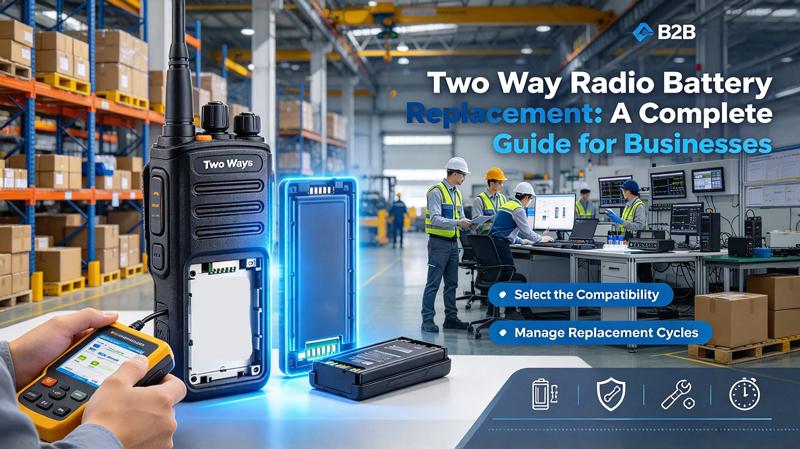
Two-way radios are essential communication tools for businesses in security, construction, manufacturing, warehousing, transportation, hospitality, and public safety. To maintain reliable communication throughout the working day, these devices need dependable batteries that deliver consistent performance.
However, every rechargeable battery gradually loses capacity over time. When a radio battery can no longer provide sufficient runtime, replacing it with a compatible, high-quality alternative becomes essential.
For businesses managing dozens or even thousands of radios, choosing the right two way radio battery replacement can help reduce equipment downtime, control maintenance costs, and improve operational efficiency.
In this guide, we explain how to identify the correct replacement battery, evaluate important specifications, avoid compatibility problems, and select a reliable battery supplier for your business.
Knowing when to replace a radio battery helps businesses maintain communication reliability and avoid unexpected interruptions. Here are several common signs that a battery may need replacement.
If a fully charged radio battery runs out of power much faster than it used to, its usable capacity may have decreased.
For teams working long shifts, reduced battery runtime can affect productivity and require more frequent battery changes.
A radio that suddenly shuts down during transmission or normal operation may have a deteriorated battery or another power-related problem.
Check the battery condition and compatibility before deciding whether replacement is necessary.
If a battery takes unusually long to charge, cannot reach a full charge, or repeatedly fails to charge, inspect both the battery and charger.
The issue may be caused by battery aging, dirty contacts, an incompatible charger, or a faulty charging system.
A swollen, cracked, leaking, or unusually hot battery should be removed from service. Do not continue using or charging a damaged battery.
Follow the manufacturer's safety guidance and arrange proper replacement and disposal.
Business tip: establishing a regular battery inspection schedule can help identify aging batteries before they affect daily operations.
Choosing a replacement battery involves more than matching the shape or finding a higher capacity rating. Several technical specifications must be checked.
Start by identifying the exact radio manufacturer and model number. Different radios from the same manufacturer may use different battery packs, connectors, and charging systems.
Record the model number from the radio label, user manual, or equipment documentation.
Whenever possible, check the model number printed on the original battery. A compatible replacement listing may reference the original battery part number, helping you identify suitable alternatives.
For businesses managing multiple radio models, maintaining a battery compatibility list can simplify purchasing and inventory management.
Voltage, measured in volts (V), must meet the radio manufacturer's requirements. Common radio battery specifications include 3.7V, 7.2V, and 7.4V, depending on the battery chemistry and design.
Do not assume that batteries with similar dimensions or connector shapes have the same voltage requirements. Always confirm the required voltage and battery configuration before ordering.
Capacity is typically measured in milliamp-hours (mAh) or amp-hours (Ah). It indicates how much charge a battery can store. For example:
May suit applications with moderate runtime requirements.
May provide a balance between runtime and size.
May support longer operation when the battery design allows it.
These examples are illustrative, not universal recommendations. Actual runtime depends on radio power consumption, transmission frequency, battery condition, temperature, and operating conditions.
A higher-capacity battery may provide longer runtime, but only if its dimensions, electrical characteristics, connector, and charging requirements are compatible with the radio.
Two common battery technologies used in two-way radios are Lithium-ion (Li-ion) and Nickel-Metal Hydride (Ni-MH).
The replacement battery must use a chemistry approved for the radio and its charging system. Do not substitute Li-ion for Ni-MH, or vice versa, simply because the voltage appears similar.
The best battery technology depends on the equipment design and the business's operational requirements.
| Feature | Li-ion Battery | Ni-MH Battery |
|---|---|---|
| Energy density | Generally higher | Generally lower |
| Weight | Usually lighter for comparable energy | Often heavier |
| Self-discharge | Generally lower | Can be higher, depending on design |
| Charging requirements | Requires a compatible Li-ion charging system | Requires a compatible Ni-MH charging system |
| Common applications | Modern portable communication equipment | Many legacy and industrial radio systems |
Li-ion radio batteries are often suitable when businesses prioritize lightweight equipment, high energy density, and longer operating time in a compact package.
They are widely used in modern professional communication equipment.
Ni-MH batteries remain a practical choice for compatible legacy radios and industrial communication systems that were designed for this chemistry.
For businesses maintaining older equipment fleets, sourcing the correct Ni-MH replacement can help extend the useful life of existing radios.
Important: compatibility should always take priority over battery chemistry preferences. The radio, battery, and charger must be designed to work together.
Incorrect battery selection can lead to charging failures, poor performance, equipment damage, or safety risks. Before placing an order, verify the following details.
The replacement must meet the radio's electrical requirements.
Confirm that the chemistry is supported by the radio and charger.
Check the battery's length, width, height, and installation method.
The terminals must align correctly and provide reliable electrical contact.
Ensure that the existing charger supports the replacement battery.
Confirm that the battery's protection system meets the equipment's requirements.
For OEM and custom battery projects, suppliers may also need information about discharge current, peak current, temperature monitoring, communication protocols, and enclosure design.
Providing complete technical information before production reduces the risk of incompatibility.
For businesses operating large fleets of two-way radios, battery costs include more than the unit purchase price. Frequent replacements, equipment downtime, logistics, and maintenance also affect total ownership costs. Consider these strategies.
Create a list of approved radio and battery combinations. Standardization can simplify purchasing, inventory management, and maintenance.
Do not standardize incompatible batteries merely to reduce the number of SKUs.
A low-cost battery may not be the most economical option if it provides insufficient runtime or requires frequent replacement.
Evaluate usable capacity, expected service life, quality consistency, warranty terms, and supplier support.
Keep appropriate spare batteries available for high-use equipment and critical operations.
Use a rotation and inspection system so that stored batteries remain in suitable condition.
For distributors, repair companies, and equipment service providers, a reliable manufacturer can help with model identification, replacement compatibility, OEM branding, and recurring supply requirements.
A dependable supply chain is especially important when maintaining multiple radio models across different locations.
Choosing the right supplier is an important part of a long-term battery replacement strategy. When evaluating a battery manufacturer, consider the following factors.
Can the supplier identify replacements by radio model or original battery part number?
Can the supplier support consistent production and repeat orders?
Are battery packs inspected and tested according to defined quality procedures?
Can the supplier adjust capacity, dimensions, connectors, or protection features when technically feasible?
Can the supplier provide relevant specifications, test information, and applicable compliance documentation?
Can the supplier assist with compatibility questions and product issues?
For B2B buyers, these factors can be just as important as the initial unit price.
Enpower Technology Co., Ltd. specializes in battery pack manufacturing and provides battery solutions for professional communication and industrial equipment.
Our product range includes two-way radio batteries, tactical radio batteries, and other customized battery packs for industrial applications.
We support battery requirements based on customer and equipment specifications, including:
Rated voltage and nominal capacity
Battery chemistry, including Li-ion and Ni-MH solutions
Battery dimensions and enclosure requirements
Connector and terminal design
Continuous and peak discharge current
Protection circuit and temperature monitoring requirements
Our customization process can include:
For distributors, repair companies, and businesses managing radio fleets, customized replacement batteries can help address specific compatibility requirements and ongoing supply needs.
To help us evaluate your project, please provide:
Contact Enpower to discuss your two-way radio battery replacement requirements.
Replacing two-way radio batteries at the right time helps businesses maintain dependable communication, minimize operational interruptions, and manage maintenance costs.
Before purchasing a replacement, confirm the radio model, original battery part number, voltage, capacity, chemistry, physical dimensions, connector, and charger compatibility.
For B2B buyers, selecting a reliable battery manufacturer also supports consistent quality, repeat purchasing, and long-term equipment maintenance.
Whether you need replacement batteries for an existing radio fleet or a customized battery pack for a specific device, choosing the right technical solution is the first step toward reliable communication.
Looking for a reliable two-way radio battery replacement supplier?
Contact Enpower Technology to discuss your battery specifications and OEM requirements.

Enpower integrates R&D, production and quality testing in-house, supporting custom battery solutions for worldwide buyers.