
📞 Tel:+86-750-3857665
Email:sales@enpowertec.com
Email:sales@enpowertec.com

A crane remote control is only as reliable as the battery pack inside it. When the pack fails, the operator loses control of the load, and on an active job site that is a safety event rather than a simple inconvenience. Choosing the right battery for a crane remote control is therefore not just a matter of finding a matching voltage number. Chemistry, capacity, dimensions, contact configuration, charging method and working environment all have to line up with the equipment.
Industrial radio remote controls are used on overhead cranes, tower cranes, mobile cranes, hoists, concrete pumps and hydraulic machinery. Many of these systems were designed around Ni-MH battery packs with a dedicated housing, connector and contact arrangement defined by the original equipment manufacturer. Others use Ni-Cd, and newer platforms increasingly use Li-ion.
This guide explains the factors that matter most when selecting a crane remote control battery, whether you are replacing a single pack or standardising batteries across a fleet of machines.
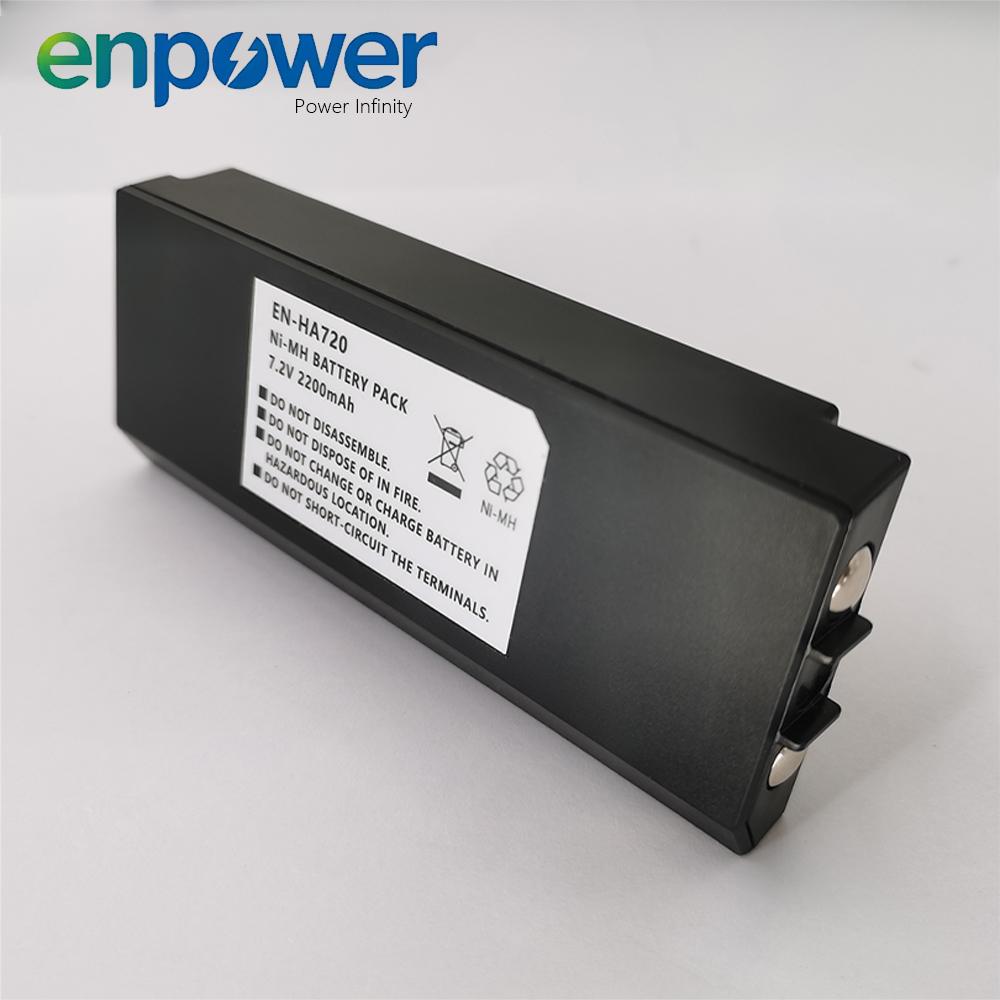
The fastest and most reliable way to identify a compatible battery is to start from the original pack. Every industrial battery carries a part number and a set of ratings printed on its label, and these provide a complete baseline for comparison.
Before searching for a replacement, collect the following information:
| What to check | Where to find it | Why it matters |
|---|---|---|
| OEM part number | Printed on the original battery label | The most direct way to find a matching replacement |
| Remote control model | Transmitter housing, equipment manual | Confirms the battery compartment and contact layout |
| Charger model | Charging cradle or plug-in charger label | Determines the charging profile the pack must accept |
| Battery chemistry | Battery label | Ni-MH, Ni-Cd, Li-ion and Li-polymer are not interchangeable |
| Nominal voltage | Battery label | Must match the transmitter electronics and charging circuit |
| Rated capacity | Battery label, expressed in mAh | Defines how long the transmitter runs between charges |
| Dimensions and contacts | Measure the original pack | A pack can match electrically and still fail to fit or connect |
Typical OEM references seen on industrial remote controls include FUB05AA, FUB10AA, BA225000, BA225030, BA210040 and 68300520. In most cases, an original part number is enough for a supplier to identify the correct replacement without any further measuring.
If the label is worn or missing, photograph the battery from several angles together with the transmitter and the charger. A battery manufacturer can often identify the correct pack from photos alone.
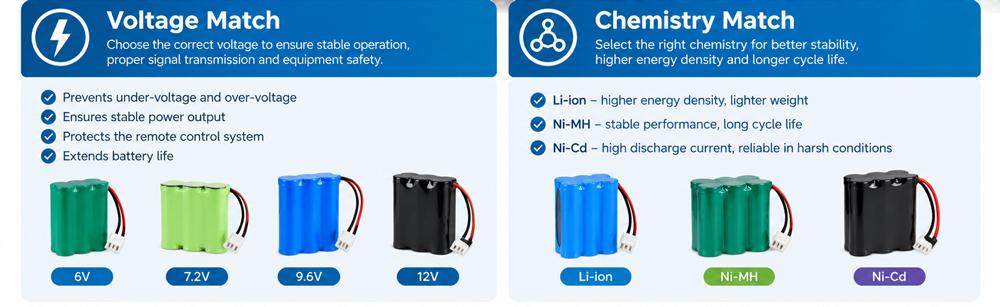
Nominal voltage must match the original pack exactly. Common industrial remote control configurations include 3.6V, 6V, 7.2V, 9.6V and 12V, and a difference such as 6V against 7.2V is not a minor variation. The transmitter electronics and the charging circuit are designed around a specific nominal voltage, so substituting a different value risks unstable operation, unreliable radio range or a charging fault.
Chemistry is equally important, and it is the specification most often overlooked.
Ni-MH (nickel-metal hydride) is the most widely used chemistry in industrial radio remote controls. It offers stable voltage, good cycle life and predictable behaviour on standard industrial chargers.
Ni-Cd (nickel-cadmium) appears on older transmitter platforms. These systems are usually specified around Ni-Cd because of their tolerance to high discharge currents and cold conditions.
Li-ion (lithium-ion) is used on newer remote control platforms where lower weight and higher energy density are priorities. Li-ion always requires a matched CC/CV charger and an integrated protection circuit.
Important: A Li-ion pack should never be treated as a drop-in replacement for a Ni-MH pack simply because the voltage appears similar. The two chemistries have fundamentally different charging requirements. Changing chemistry means changing the charging system as well, so it has to be evaluated as a complete system together with the charger and the transmitter.
Enpower's industrial remote control range follows this principle rather than a generic voltage standard. The EN-HB205 is a 6V 2200mAh Ni-MH replacement battery for HBC crane remote controls, supporting OEM references such as FUB05AA, BA225000 and BA225030. The EN-HE510 uses a 9.6V Ni-MH configuration for Hetronic industrial remote control systems. Each pack is built to the electrical profile of the equipment it serves.
Capacity, expressed in mAh (milliamp-hours), determines how long the transmitter will operate between charges.
As a rough estimate, runtime in hours is equal to the pack capacity divided by the average current draw of the transmitter in milliamps. In practice the average draw depends on how frequently the operator transmits, how long the transmitter stays powered between lifts, and how much time the machine spends idle with the controller switched on. The same pack can therefore cover a full shift on one crane and only a few hours on another.
Typical capacities in this segment include 700mAh, 750mAh, 1700mAh, 2000mAh and 2200mAh, along with customised values. For reference, the EN-AU06 uses a 7.2V 750mAh Ni-MH configuration for compact Autec systems, while the EN-SC561 is a 7.2V 2200mAh pack for Schwing concrete pump remote controls where longer runtime matters more than size.
More capacity is not automatically better. A higher rating usually means more cells in the pack, which makes it larger, heavier and slower to charge, and the housing may no longer fit the original compartment. The practical target is a pack that covers one full shift, or one defined rotation period, with enough margin for cold weather and normal cell ageing, while still dropping into the original space.
When a site genuinely needs longer runtime, adding a second pack to the rotation is usually more reliable than forcing a larger pack into a housing that was not designed for it.
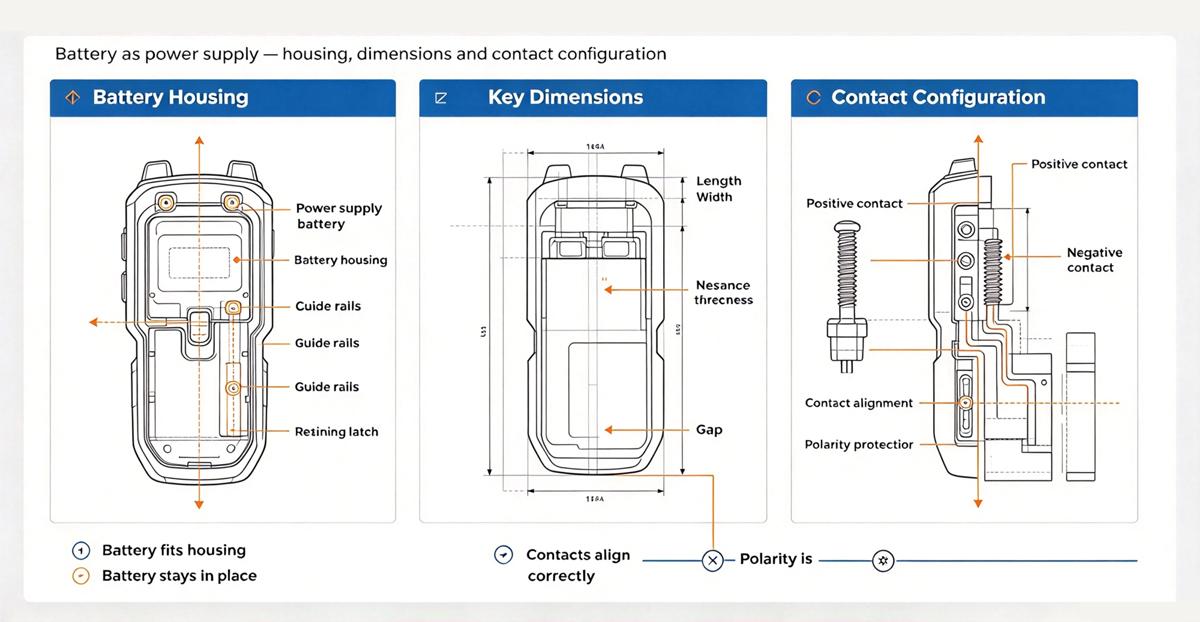
Electrical compatibility alone does not make a usable battery. The pack also has to seat correctly in the transmitter and make consistent contact with the charging cradle.
Measure and compare three things:
Dimensions - length × width × height, including any raised section or latch feature.
Retention - how the pack is held in the compartment, whether by a latch, a clip, a housing rib or a screw, and how it is released.
Contacts - the number of contacts, their position, spacing, polarity, and whether separate charging contacts are used by the cradle in addition to the operating contacts.
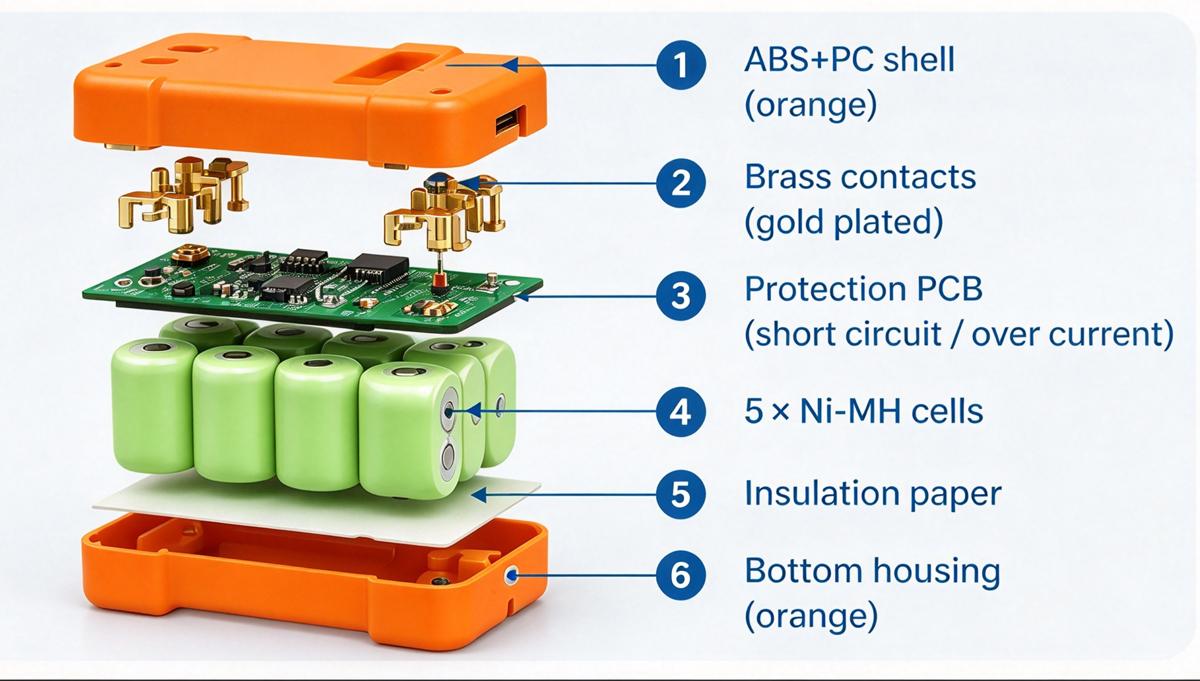
Contact quality has a direct effect on reliability. Gold-plated or nickel-plated contacts resist oxidation and maintain a stable connection over many insert and removal cycles. A pack that seats loosely, or whose contacts sit slightly out of position, can produce intermittent signal loss that is easily misdiagnosed as a radio fault.
Housing construction matters in the same way. A high impact ABS/PC composite housing with a reinforced structure keeps the pack rigid during daily handling and protects the cells against impact, dust and moisture in demanding industrial environments.
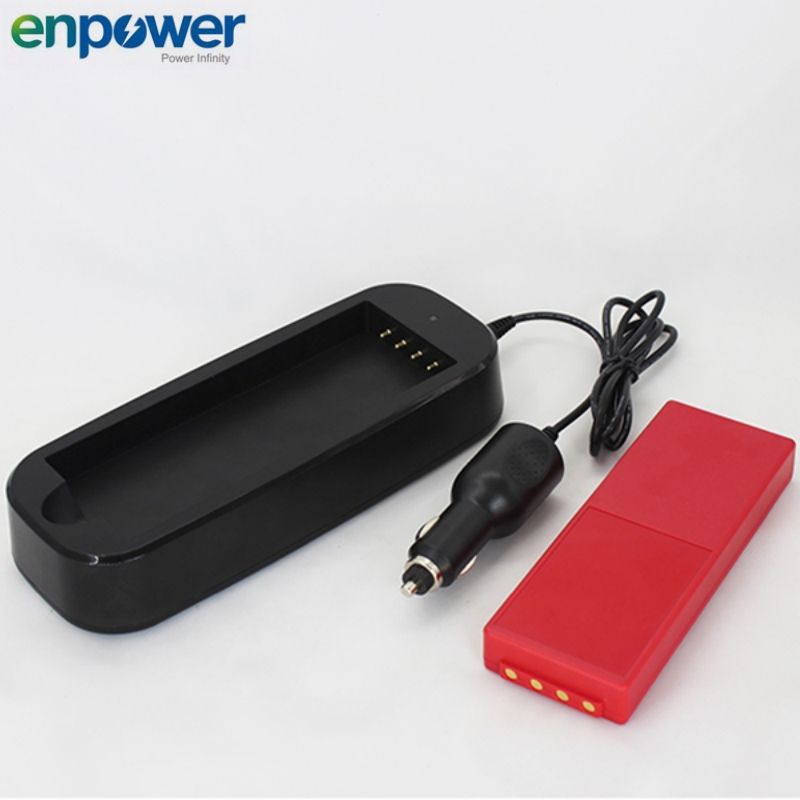
A battery is only half of the system. The charger has to match as well, and for industrial remote controls the charging arrangement is part of the battery specification.
Check the following before ordering:
Whether the pack charges in a cradle, on a plug-in charger or through a separate charging connector
The position of the charging contacts and whether they align with the existing cradle
The charge current and charge termination method expected by the pack
Charging time compared with shift changeover, and whether spare packs are needed
Ni-MH packs are normally charged with a temperature or delta-V terminated charger. Li-ion packs require constant current / constant voltage charging together with overcharge protection. Charging a pack on a mismatched charger can overheat the cells, damage the protection circuit or permanently reduce capacity.
For fleets, plan charging time against the real rotation on site. If a pack needs five hours to charge but shifts change every four, the correct answer is additional spare packs rather than a faster charger.

Where the crane works is part of the battery specification. Two sites using the same transmitter model can reasonably need different packs.
Ports, yards and outdoor sites in summer. High ambient temperature accelerates cell ageing and increases self-discharge. Spare packs should not be left in a cab or container in direct sunlight.
Cold storage, refrigerated warehouses and winter operation. Usable capacity drops at low temperature. Specify a pack with margin, or a chemistry that performs better in cold conditions, and allow for the drop in the runtime calculation.
Steel mills, foundries and casting areas. Radiant heat is the dominant stress. The pack has to tolerate high temperature without deformation or loss of protection function.
Dust, rain and washdown. Housing design, gasket quality and contact protection decide whether the pack survives the environment.
Continuous vibration and shock. Reinforced housing and secure internal cell retention prevent movement that would otherwise fatigue internal connections.
For most industrial remote control applications, an operating range of roughly -20 °C to +60 °C covers the majority of installations. Confirm the actual figures with the equipment documentation and state them when requesting a replacement, because the temperature range can rule out an otherwise compatible pack.
The three chemistries commonly found in industrial remote controls differ in ways that matter directly to the buying decision.
| Consideration | Ni‑MH | Ni‑Cd | Li‑ion |
|---|---|---|---|
| Typical use | Most industrial crane and concrete pump remote controls | Older transmitter platforms | Newer remote control systems |
| Energy density | Moderate | Lower | Highest |
| Weight for the same capacity | Moderate | Heaviest | Lightest |
| Memory effect | Minimal | More pronounced | None |
| Charging | Standard industrial charger with temperature or delta‑V cut‑off | Charger matched to the pack, with attention to cadmium disposal | CC/CV charger and integrated protection circuit required |
| Best suited to | Straight replacement of an existing Ni‑MH pack | Legacy equipment specified around Ni‑Cd | New designs where weight and runtime are priorities |
| Watch out for | Reduced capacity in cold conditions | Environmental and disposal compliance | Overcharge and over‑discharge must be managed by the pack |
As a rule, keep the chemistry that the equipment was designed for. A chemistry change is a system change and should only be made together with the charger and the transmitter.
Protection features are not a marketing detail on an industrial battery. Depending on the chemistry and the design, a professional pack may include:
Short-circuit protection
Over-current protection
Over-charge protection
Over-discharge protection
Temperature monitoring
On Li-ion packs, a battery management system is essential rather than optional. It keeps the cells inside their safe operating window and prevents the failure modes that are inherent to the chemistry when it is misused.
Documentation matters as much as hardware in industrial procurement. Orders placed by OEMs, rental companies and maintenance contractors usually require a UN38.3 test report, an MSDS and declarations such as CE and RoHS, particularly when packs are shipped as dangerous goods. Selecting a supplier who can provide these documents with the product avoids delays later.
Safety note: if a pack becomes swollen, unusually hot, emits an odour or shows any sign of physical damage, stop using it immediately, isolate it from other batteries and contact a qualified supplier. Never attempt to force a damaged pack into a transmitter or onto a charger.
For most users, a standard replacement pack built to the original specification is the fastest and most cost-effective solution. It requires no design work, no tooling and no change to the charging system.
A custom pack becomes the better option when:
The original battery is discontinued or no longer available
No suitable aftermarket replacement exists
The runtime supplied by the original pack is not enough for the actual working shift
The operating environment has changed and a different housing or protection level is needed
The transmitter or charger has been modified
The equipment requires private labelling or OEM packaging
Customisation typically covers voltage, capacity, dimensions, housing, connector, contact position, chemistry, protection circuit, label and logo, and OEM/ODM packaging. Enpower supports both standard replacement orders and fully customised industrial battery projects, and the same engineering process applies to each.
Before confirming an order, work through the following list. If every item is verified, the risk of selecting an incompatible battery is significantly reduced.
✓ OEM part number of the original battery
✓ Remote control model and charger model
✓ Battery chemistry (Ni-MH, Ni-Cd or Li-ion)
✓ Nominal voltage
✓ Rated capacity in mAh and the runtime it provides
✓ Dimensions and retention method
✓ Connector and contact configuration, including charging contacts
✓ Charging method and charge time
✓ Operating temperature range and environment
✓ Protection functions and required documentation
✓ Required quantity and spare pack rotation
Common configurations include 3.6V, 6V, 7.2V and 9.6V, with 12V used on some larger industrial control systems. The correct value is the one specified for the particular remote control model.
No. A higher capacity pack may provide longer runtime, but it is usually larger, heavier and slower to charge, and it has to fit the original compartment and remain compatible with the charging system. Correct compatibility comes before maximum capacity.
Not as a direct drop-in replacement. Li-ion and Ni-MH packs have different charging requirements, different voltage behaviour and different protection needs. A complete system evaluation covering the pack, the charger and the transmitter is required before any chemistry change.
Check the original pack for the part number, voltage, capacity, chemistry and dimensions, then note the remote control model and the charger model. Photographs of the battery, the transmitter and the charging contacts are often enough for a manufacturer to confirm the correct replacement.
When the original pack is discontinued, when no reliable replacement is available, when the required runtime cannot be met by a standard pack, or when the equipment needs specific dimensions, contacts, protection or branding. Custom packs are designed around the equipment requirements rather than around a catalogue number.
Yes. Rotating two packs means each one is discharged less deeply and has time to cool between charges, which reduces stress on the cells. It also removes the temptation to fast-charge a pack that is needed for the next shift.
A crane remote control battery has to work with the transmitter, the charger, the battery compartment, the contact arrangement and the working environment as a complete system. Voltage and capacity are only the starting point; chemistry, physical fit, charging method and protection features decide whether the pack performs reliably over its full service life.
Enpower provides replacement and customised battery solutions for overhead cranes, mobile cranes, tower cranes, hoists, concrete pumps, hydraulic equipment and industrial wireless control systems, covering Ni-MH and other chemistries in a range of voltages and capacities.
Whether you need a replacement pack based on an existing OEM model or a fully customised battery for a fleet or a new design, our engineering and manufacturing team can develop a solution around your equipment requirements.
Send us your battery model, voltage, capacity, dimensions or a photo of the original battery, and we will help you identify the right pack.
Enpower Technology Co., Ltd.
Custom Battery Pack Manufacturer
Contact us for your crane remote control battery solution.

Enpower integrates R&D, production and quality testing in-house, supporting custom battery solutions for worldwide buyers.